Your Imposter Syndrome Is Telling The Truth
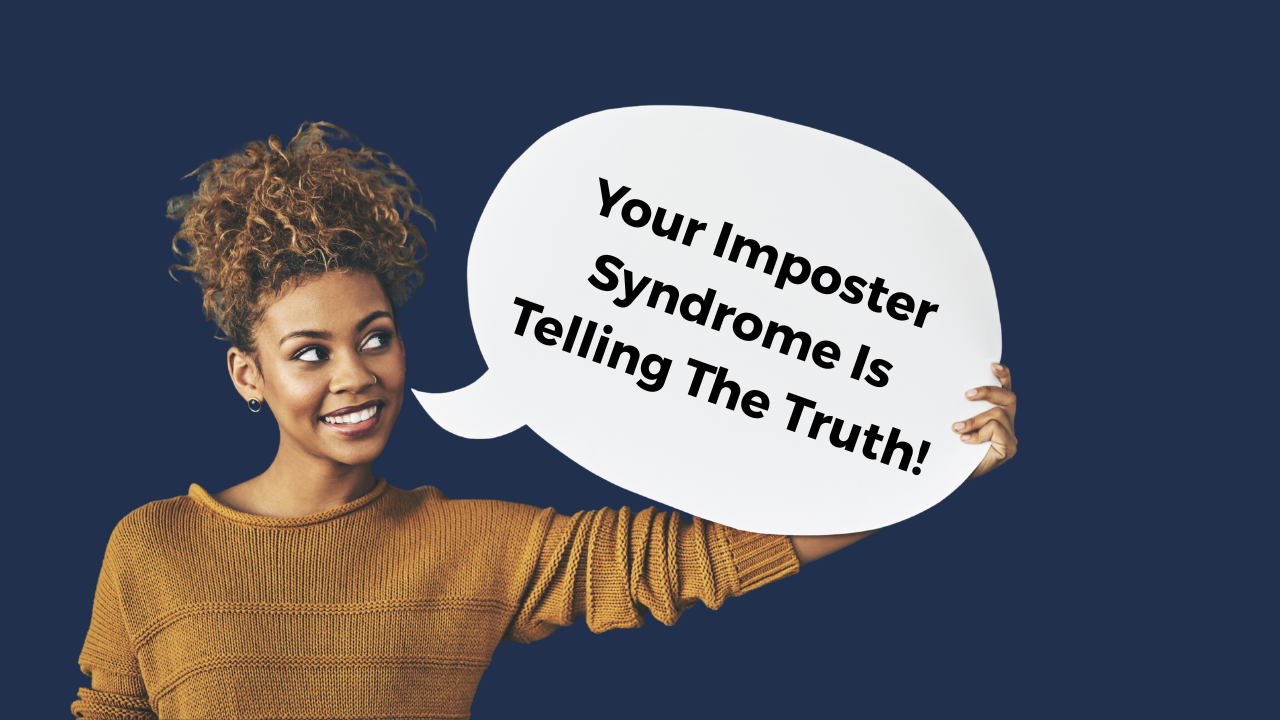
Jun 19, 2026What if your imposter syndrome isn't broken? What if you are trying to belong in rooms that were never meant for you? Imposter syndrome is often an accurate signal that an environment doesn't fit you, not proof you're not good enough.
I work with imposter Parts a lot in my practice – the ones people often say are massively getting in the way of them doing things differently. The Parts that say, "Who are you, with your big ideas? Who are you, some kind of expert? By the way, if you go outside the Normal Box in your practice, people are going to see there's nothing behind the façade and you'll be found out."
I've noticed this showing up in coaching sessions with my clients. People who experienced crushing imposter syndrome in one environment – a corporate job, a misaligned sector, a toxic workplace – find that same Part becomes noticeably quieter when they change contexts. Not because they'd finally accumulated enough evidence of being worthy, but because they had found a space where they felt more aligned with the prevailing values and aspirations. Somewhere that felt closer to home.
What if your imposter syndrome isn't the problem? What if it's a part of you telling the truth about aspects of your workplace that are draining the life out of you?
A Secret Truth, Revealed Indirectly
Sometimes the imposter part is detecting a real mismatch between who you are and where you work.
What emerges through these conversations is something we rarely consider: sometimes our imposter Parts are aware that there's a mismatch between who we are authentically and the environments we've been showing up in.
We often talk about the imposter Parts as though they're just a hindrance. Even when we believe they have the best intentions for us and are trying to keep us safe by keeping us small, we don't necessarily think they are also bringing a valuable perspective.
Yet, what if imposter Parts have been keeping us small in spaces that are out of alignment with us in some way?
What if we entertained the idea that they know something we don't?
If that's possible, listening to those Parts and asking about the insights and perspectives they hold can unearth valuable wisdom.
The Felt Sense of Misalignment
In Internal Family Systems (IFS) work, every part has a positive intention, so the question to ask the imposter is what it's protecting you from staying in.
The inner critic isn't tormenting us for sport – it's trying to keep us safe from vulnerability, from rejection, from being fully seen and potentially found wanting, for example. These protective Parts develop sophisticated strategies to shield the younger, more vulnerable Parts of us that carry shame and unworthiness.
Here's the question we rarely ask these protective Parts: What are you trying to protect me from staying in?
The deeper role of the imposter part could be in helping us recognise our felt sense of misalignment. Maybe it's not only trying to keep us small for the sake of smallness. It could be trying to get us to feel something we've been trained to override: This doesn't fit.
Something I've been exploring in my work around regenerative practices is how institutionalisation – the process of conforming to professional stereotypes – serves to reduce our awareness of the extractive business models on which those stereotypes are based. We get taught to overlook certain signals in the name of professionalism.
Give more. Be more productive. Ask for less support. Expect less.
(I talk more about the impact of extractive business models on private practice in this podcast.)
This is where institutionalisation does its most insidious work. We learn to tune out our inner wisdom. We're taught that professional environments require us to perform versions of ourselves that aren't quite true, and to suppress the signals that say, "something's wrong here," to believe that discomfort means we need to try harder rather than listen more carefully to ourselves.
In IFS terms, what happens in toxic work environments is that our manager Parts, the protective parts that try to keep us safe through overworking, perfectionism, and avoiding vulnerability, go into overdrive.
Deinstitutionalising ourselves, re-humanising and rewilding ourselves and our practices, starts with waking up to our inner signals, especially those about what's happening in our environment. In this context, the imposter Part isn't really an inner block that's keeping us from success (though it's keeping us from successfully performing the extractive paradigm, perhaps). It's an environmental sensor trying to tell us something essential about where we are, whether that place is truly life giving to us, and whether we truly belong there.
What if these aren't inner blocks at all? What if these are inner signals trying to get us back on track – not just to reconfiguring our internal psychology, our relationship with the Parts of us that felt out of alignment, but to reconfiguring our practices on the outside too. That's when we start to see system change on the outside as well as the inside.
No wonder the prevailing culture pushes against it.
Imposter Syndrome is a Culture Problem, Not a Confidence Problem
Imposter syndrome tracks with workplace culture, not skill: 71% of CEOs report it while knowing they're competent. 43% of employees experience imposter syndrome. Searches for "imposter syndrome" surged 75% in 2024.
What makes this especially revealing is that the Korn Ferry research found that CEOs and senior executives experience imposter syndrome at more than double the rate of early-stage professionals – 71% versus 33%. These are people at the top of their fields. Eighty-five percent of CEOs express total competence in their ability to perform their roles.
They know they're competent. Yet the imposter Part still yells at them.
Fewer than half of employees (49%) feel comfortable being themselves around colleagues. Their 'imposter syndrome' isn't correlating with lack of skill. It's correlating with lack of authenticity, which is usually described as 'not being able to be myself fully at work'.
And here's what the 2025 research indicates: organisations that emphasise competition over cooperation significantly increase imposter syndrome. It's the culture, not the person. When workplaces foster competitive atmospheres where employees constantly compare themselves to high-performing colleagues for promotions or recognition, imposter feelings intensify. This pattern holds true regardless of gender, age, or background.
In contrast, cooperative work climates that prioritise learning, mastery, and mutual support don't show the same increase in imposter feelings. In fact, they may actually buffer against it.
Given the changes experienced in the world of work in the last few years, not all of them for the better, it piques my curiosity that imposter syndrome searches have been climbing too. As a practitioner, I wonder if people's sense of misalignment with aspects of the workplace is also growing.
Forbes puts it plainly: "imposter syndrome isn't a confidence problem – it's a culture problem." Research from Fast Company highlights, for example, that competitive work environments drive imposter syndrome, regardless of gender.
The imposter Part speaks louder in toxic environments. It intensifies in spaces that demand performance over authenticity, credentials over insight, conformity over truth-telling.
So why do we keep treating it as an individual pathology? An internal problem to solve by getting our imposters to pipe down and our inner strivers to bust through.
Why More Certifications Don't Fix Imposter Syndrome
Another credential rarely quiets the imposter part, because the problem was never a missing qualification.
I've also seen this focus on quieting or busting through our imposters show up across our professions in other ways. 'Imposter syndrome' shows up a lot in private practice with practitioners going from certification to certification, always thinking the next proof point is going to be the one that convinces the imposter Part that they're now enough.
The cost of treating the symptom instead of the environmental misalignment is often directly thousands of pounds. Therapists and counsellors spend £1,600–£3,200 annually on continuing education. Specialised certifications in EMDR or IFS cost thousands in mandatory workshops and supervision. ICF coaching certifications range from £2,700 for ACC to over £12,000 for MCC.
And here's the darkly ironic part: there's now an entire certification industrial complex specifically for treating imposter syndrome itself. Practitioners can pay for specialised imposter syndrome trainer certifications and CPD courses, marketed to mental health professionals who want to help their clients with... the exact problem that certification culture helped create.
The imposter Part watches all of this. It sees us accumulating credentials for spaces that perhaps never felt right in the first place. Sometimes it speaks even more loudly: "Even with all these qualifications, you still don't feel like you belong. Maybe that's telling you something."
We interpret this as evidence of our own brokenness: "I must really be inadequate if even this certification didn't fix me."
The imposter Part isn't the problem but the signal of the problem - an environment built, even inadvertently, to extract value rather than a place full of life-giving potential.
The Sacred Cow of Professionalism
Treating certifications as a cure for imposter syndrome keeps an extractive economy alive inside the profession itself.
I do find it super interesting that questioning credentialing is almost a sacred cow within our field. Feeding our own imposter syndrome as practitioners through the endless certification and CPD accreditation systems we have is an important extractive economy right in the heart of our own profession.
I'm not suggesting credentials have no value or that professional development doesn't matter. I'm asking us to notice what happens when we treat certifications as the potential cure for imposter syndrome rather than what they are: tools that serve a specific purpose in specific contexts, or even just enjoyable explorations. Manna for the Parts of us that love to learn and connect.
When we, as practitioners, spend thousands trying to "fix" our imposter syndrome through more training, more credentials, more proof of our enough-ness – we have to ask: What are we protecting ourselves from recognising? That we might be trying to prove ourselves worthy of environments that were never aligned with who we are. That require us to mask and hide important Parts of ourselves.
If we asked questions about that lack of alignment, questions that challenge the ways in which we've been required to mask Parts of ourselves, dehumanise ourselves or others around us, what might we discover? That the problem isn't us but the extractive, toxic, and sometimes dehumanising workplaces we've been navigating, even those that we've created for ourselves as an escape from some other workplace. Extractive business is a pattern, a format, that so familiar that we can end up replicating it in our practices without realising.
What Becomes Possible in Our Practices If We Listen to the Imposters
Imagine a practice that is informed by and grows from more Parts of you – a place where more Parts of you can show up and feel safe. This always feels to me like the first step in creating a regenerative practice, and it becomes a practice in itself. This perspective isn't new either; it has resonance in positive psychology of strengths. For example, Professor Alex Linley wrote in his book Average to A+ about marshalling more of our realised and unrealised strengths and tied that to improved organisational performance. What if the same principle applies to our practices? When more Parts of us can feel at home in our workplaces, we are more likely to thrive.
This includes having more Self leadership, as described by Richard Schwartz PhD, founder of IFS. More self-compassion and inner curiosity. A practice where even the Parts that feel anything but strong, who feel overwhelmed at work, can find compassion, hope, and even healing rather than self-criticism and exiling.
Where you know that the clients who find you are drawn to your way of being in the world beyond the certificates. Where you wake up without that gnawing sense of performing someone else's version of professionalism. Where the imposter Part goes quiet – not because you've finally "fixed" yourself, but because there's nothing left to protect you from. Where it can even become a trusted advisor, helping you notice when something starts to drift out of alignment again.
This isn't fantasy because I've seen it happen hundreds of times over the last years of working with regenerative principles in our private practices. It's what happens when practitioners stop trying to fit a model of professionalism that has stripped them of a felt sense of safety and start creating from a place of more Self trust and a reverence for what is life giving.
Listening to The Oracle
What if, instead of asking "How do I overcome my imposter syndrome?", we asked:
- What is this Part trying to protect me from staying in?
- What feels out of alignment for this Part?
- What hope does this Part hold for me?
- Why does this Part feel a misalignment here, specifically?
- What would feel like alignment – this Part keeping quiet, or me being in a different room?
It may be that the imposter Part isn't broken. It's doing exactly what it's there to do: acting as a misalignment detector. When it signals danger, it's not necessarily warning you that you're inadequate. It could be warning you that something about this environment doesn't fit who you truly are.
Your inner system will signal when something is out of balance around you any and every way it knows how. Imposter syndrome may well be just one of those signals. One of the loudest, perhaps. One of the most persistent. Sometimes overburdened.
What if we stopped trying to silence it, got curious and started asking questions and listening to what it knows?
Imposter syndrome isn't just the trailhead to endless exhausting self-improvement programmes and certification courses. It could also be the trailhead to your most potent inner alignment wisdom. The Part you've been trying to fix might be the only one brave enough to tell you the truth: you're trying to belong in a room that was never meant for you.
The Oracle has been speaking all along. The question is: are you finally ready to let it guide you home?
Try this:
This week, when the imposter part speaks, don't try to silence it. Ask it one question: What are you trying to protect me from staying in? Write down what comes up. That's the trailhead.
Wendy Kendall is a Chartered Occupational Psychologist and Coaching Psychologist, one of a small number of organisational psychologists trained to IFS Level 3 with the IFS Institute. Over nearly 30 years she's worked across global talent development and now helps psychologists, coaches and consultants rebuild their private practices into something that fits who they actually are. She writes on parts work, regenerative practice, and the psychology of business. More about Wendy
Article FAQ
Can imposter syndrome mean you're in the wrong job?
Yes. Imposter syndrome can be a signal that an environment doesn't fit who you are, not evidence that you lack ability. If we're referring to Parts, the imposter part often works as a misalignment detector, flagging that a role, a sector or a culture isn't right for you rather than that you're not good enough for it.
Why do I still feel like an imposter after years of experience?
According to research, imposter syndrome tracks with workplace culture and authenticity rather than with skill or how long you've done the job. Senior leaders report it at more than double the rate of early-career people while still rating themselves fully competent, which suggests the feeling is picking up on the environment, not a gap in your ability.
Will another qualification fix my imposter syndrome?
Not always, because imposter syndrome rarely comes from a missing credential. If the feeling is signalling a mismatch between you and where you work or aspects of how you're working, another certificate may just treat the symptom, and the imposter part can get louder once the new letters still don't make you feel like you belong.
Is imposter syndrome a confidence problem or a culture problem?
More often a culture problem than a confidence problem. Competitive, perform-or-perish environments measurably increase imposter feelings, while cooperative, learning-focused cultures seem to buffer against them, which points at the conditions rather than the person.
