
Psychology Needs a New Model of Professional Development
Aug 31, 2026Why expertise development alone is not enough for a profession facing disruption
Psychology has well-established pathways for developing expertise. In a disrupted world, we may also need pathways for developing practitioners who can author, adapt and lead work when the route ahead is not already defined.
One of my favourite ways of describing private practice is that it is a little bit like being in The Lord of the Rings. One minute you are a hobbit happily gambolling through the Shire, and the next you are in the Forest of Fangorn fighting orcs. We laugh about this in our programme The Psychology Practice Accelerator (TPPA), but there is something quite serious underneath the joke.
I think many of us carry an implicit idea of professional development that looks rather like climbing a mountain. We train, qualify, deepen our expertise, become more experienced and, hopefully, gain an increasingly clear view of who we are professionally, what we do and where we are going.
The difficulty is that the world does not stay still while we are climbing.
We change as people and as our lives change. The people and communities we serve change. Technologies emerge. Institutions and markets shift. Political, economic and environmental conditions change around us. Work that once felt secure can become less so, while completely new questions and possibilities appear.
Sooner or later, the map that used to make sense stops making quite so much sense. That can feel deeply uncomfortable. We tend to interpret professional uncertainty as a sign that something has gone wrong. Perhaps we need a clearer niche, a better strategy, more training, a different role or simply more time to think.
But over the past couple of years I have started wondering whether some of that uncertainty is telling us something else. Perhaps the problem is not always that we have failed to follow the existing professional map. Perhaps, the map itself is no longer sufficient for the terrain we are navigating.
When the existing model stops explaining what you can see
Thomas Kuhn famously wrote about scientific revolutions as periods in which a dominant paradigm works reasonably well until anomalies begin to accumulate. Questions appear that it cannot quite answer, new evidence no longer fits neatly inside it, and eventually another way of understanding what is happening becomes necessary.
I had seen something similar in organisations through my own Masters research for Cranfield School of Management, where I was looking at strategic drift. What interested me was that executive teams who managed to pull their organisations out of drift were better at not incorporating every new anomaly into their existing worldview. They noticed the accumulating red flags and were able to reformulate their perspective. Once the frame changed, different strategic possibilities became visible to them. That idea has stayed with me.
Sometimes the challenge is not to become better at making the existing model work. Sometimes the accumulation of things that no longer quite fit is telling us that the model itself needs to be reconsidered.
During much of 2025, I felt as though I was wading through treacle. There was a lot happening geopolitically that felt difficult to absorb. Private practice itself seemed to be changing quickly, and I had a growing sense that regenerative practice needed to become a more explicit part of what we were doing at Inspiring Psychology.
At the time, I thought I had a clarity problem. I needed clearer messaging, better positioning and better words for something I could sense but could not yet articulate. That process eventually led me to create Private Practice in the WTF Era, a private podcast series exploring some of the changes I could see happening around psychological practice. Nearly a thousand people have since downloaded and listened to it, and for a while I felt clearer.
Then more anomalies started accumulating.
There was increasing discussion about what gets called AI at the moment and what it might mean for the delivery and economics of psychological work. There were concerns about established training pathways, including Stage 2 routes in occupational and counselling psychology, alongside wider conversations about psychologists in training struggling to find meaningful work and experience.
More psychologists seemed to be entering private practice earlier in their careers. Dr Esther Cole and I were asked by the British Psychological Society to develop a course on flourishing in private practice. People concerned with the longer term development of the psychological workforce were asking bigger questions about what psychologists might need in the future.
At Inspiring Psychology, larger psychology practices, charities and professional organisations were increasingly approaching me for strategic organisation development work, including support to develop new products and services, rethink their missions and consider how their organisations needed to evolve.
Within our own community, the conversation was moving far beyond the mechanics of running a practice. We were talking about activism, systemic injustice, climate, regenerative practice, professional responsibility and the relationship between earning a living and contributing to something larger.
None of those things, on their own, gave me an answer, but together they made the question I had been asking feel increasingly inadequate.
Perhaps the challenge was not simply:
How do psychologists build better practices?
Perhaps it was:
What kind of professional development do psychologists need if they are going to remain successful, resilient and able to respond to a world that is being disrupted?
Psychology has been sitting with part of this problem for decades
Around the same time, I found myself returning to work first published nearly forty years ago. In 1989, applied psychologist Prof. Derek Mowbray authored the MAS Review of Clinical Psychology and described three broad levels of psychological work.
At Level 1 sits everyday relational and psychological support. “I help.”
At Level 2 sits structured and often protocol-based intervention, including established forms of therapy, assessment and psychological delivery. “I treat.”
Level 3 is qualitatively different. It involves discretionary, strategic psychological work in which practitioners draw flexibly from theory, evidence and professional judgement to respond to complex situations where there may be no standard protocol to follow. “I lead.”
What struck me when I returned to Derek’s work was how longstanding this challenge was. By 2009, twenty years after the original review, he was still expressing concern that too much psychological capability remained concentrated in Level 2 delivery. His vision had been much larger, with psychologists contributing more strategically to health, wellbeing, prevention, policy and wider systems.
Yet decades later we can still see highly trained practitioners spending enormous amounts of their professional lives delivering work designed elsewhere. In the NHS this may take the form of protocolised interventions within tightly prescribed services. In private practice it can look very different on the surface while retaining much of the same underlying structure: a full diary of one-to-one work, assessments, reports, another modality, more clients, perhaps an associate or two.
All of this can be valuable work and can do enormous good. The question is what happens when delivery absorbs almost all of our professional capacity.
If most of our time and energy is repeatedly consumed by work that already exists, how much space remains to develop the ideas, relationships, methodologies, research, intellectual property or strategic contribution that might become the foundations of what comes next? And if we can't respond, how do we avoid strategic drift?
There is also something psychologically attractive about delivery. It offers a degree of certainty. There is a client, an appointment, a recognised intervention, a professional framework and usually a clearer sense of what happens next.
In an email exchange in 2025, Derek made an observation that stayed with me:
“Level 3 work is by definition uncertain.”
That matters because psychologists spend years becoming increasingly competent within areas of expertise where there are pathways to follow and markers that tell us we are progressing.
Strategic work asks something different of us. It requires us to exercise judgement when there is no protocol, make sense of complexity, connect ideas that may not have been connected before and sometimes create a response rather than select one that already exists.
The more I thought about this, the more I began to wonder whether psychology has become very good at developing practitioners for increasing expertise within established forms of work, while providing much less explicit development for the work that begins when the pathway itself is not already defined.
A stable ladder in an unstable world
Derek’s original framework was progressive. As psychologists developed, the intention was that they would increasingly move towards Level 3 work, while other parts of the workforce could take on more Level 2 delivery.
However, the more I looked at the practices around me, the less convinced I became that a ladder was the right metaphor for the world we now inhabit. The practitioners doing some of the most interesting work were not leaving Level 1 or Level 2 behind. They were moving flexibly between different forms of psychological contribution. Someone might work deeply with an individual, develop a programme for a community, advise an organisation strategically and collaborate across disciplines or sectors on a much larger problem.
The different forms of work were nested inside one another. So I started drawing the model as circles instead.
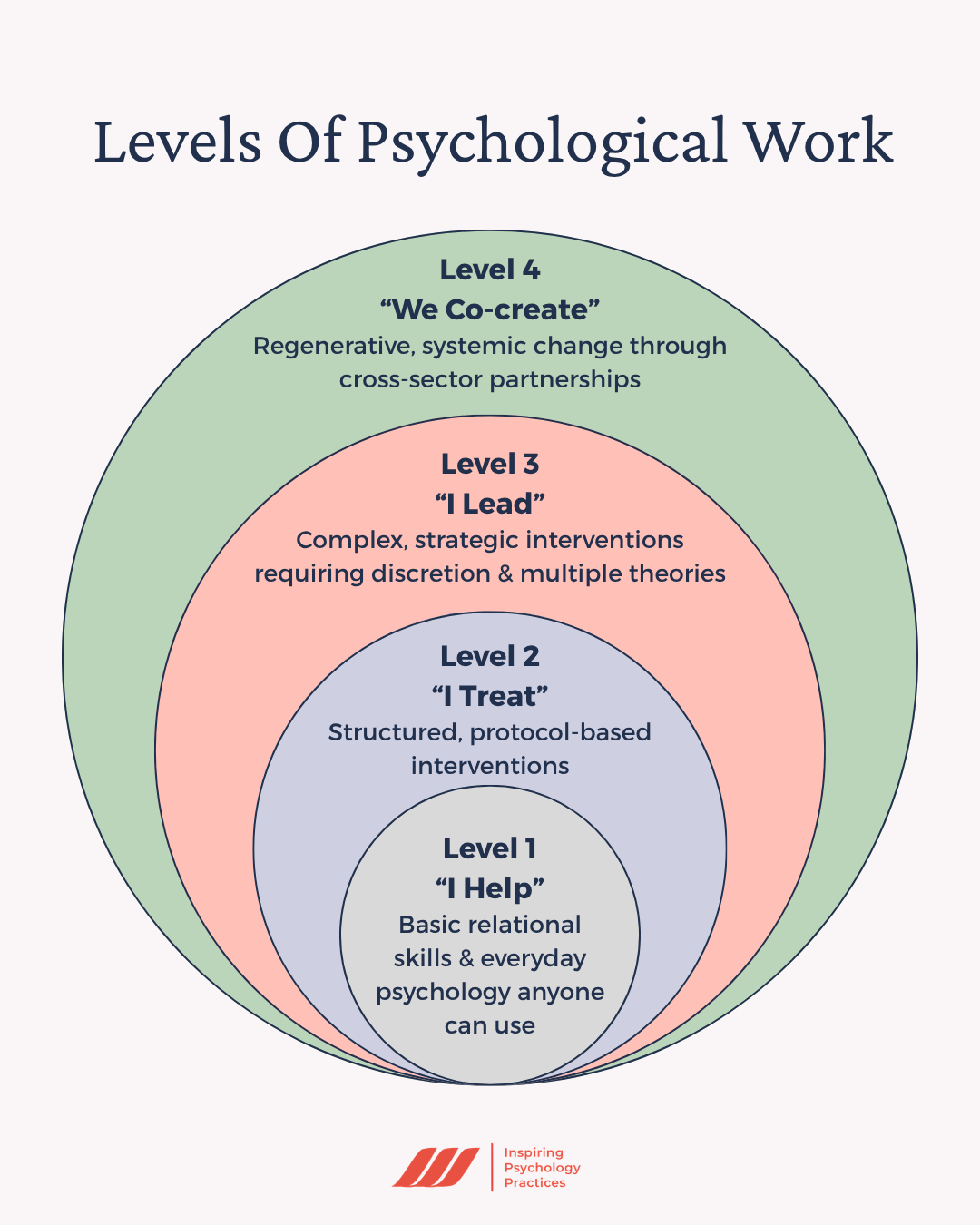
Level 1, “I help”. Level 2, “I treat”. Level 3, “I lead”, and around them, a fourth space that had increasingly been emerging in conversations within our community: Level 4, “We co-create”.
For me, Level 4 was less about adding another rung to a professional hierarchy and more about recognising a regenerative orientation to practice, one in which psychologists work across traditional boundaries and in relationship with communities, disciplines and systems.
It also reflected something that had been bothering me about conventional models of career development for psychological practitioners.
A career ladder assumes a relatively stable world. You qualify, progress, accumulate expertise and move through increasingly senior or specialised roles.
But what happens when the institutions themselves are unstable? When professional pathways change? When technology alters how psychological services are delivered? When previously reliable sources of work disappear? When new problems emerge that do not fit neatly inside a single service, profession or discipline?
A stable ladder becomes less useful when the ground underneath it is moving. That left me with another question. If psychology has been talking about the need to move beyond delivery for decades, why do some practitioners appear to make that transition while so many others remain predominantly caught in delivery?
What the practitioners who move beyond delivery do differently
Instead of continuing to examine the problem, I started looking much more closely at the practitioners who seemed to be developing differently. I have had the privilege of working alongside many of these people over the past eight years, through coaching, twelve cohorts of The Psychology Practice Accelerator and the professional community that has grown around our work. Of course, this is not formal research but this is my observation as an occupational psychologist from years spent supporting psychologists and psychological practitioners as their work develops.
When I look across them now, I can see a pattern much more clearly than I could when I first created TPPA. They have not simply become more expert or better at business.
- They have become more self-authoring.
- They have worked intentionally on their self-leadership and become more willing to trust their own professional judgement.
- They have learned to notice the questions, patterns and problems that matter to them rather than waiting for somebody else to define the next professional pathway.
- They have integrated their experience, expertise, the literature, their values and what they can see happening in the communities around them.
- From that, they have begun developing ideas, perspectives, methodologies, products, services and ways of working that are increasingly their own.
Some have developed highly recognisable bodies of work over a number of years. Michelle Minnikin, for example, brought together her organisational experience, psychological knowledge and observations about the socialisation of women to develop her work around Good Girl Deprogramming. Dr Hannah Bryan integrated her experience in EMDR and coaching into EMDR-informed coaching.
But those are only two examples of a much broader pattern.
Across the psychologists and psychological practitioners we have worked with, I have seen people develop new responses to neurodivergence, identity, work, leadership, psychological safety, systemic injustice and organisational life. I have seen them create new assessment and support pathways, build communities, influence policy and systems, develop methodologies and intellectual property, work across professional and sector boundaries, and bring psychological thinking into places where it had not previously had much influence.
What interests me is not the particular form any one of those practices takes. It is the developmental process underneath them.
What that looks like in practice
These practitioners have become increasingly willing to stay with questions for which there is no prescribed pathway. They become curious about what they are noticing, what their experience is teaching them, what appears to be missing from existing conversations, what happens when different strands of knowledge are brought together and what the people and communities they care about serving actually need.
Then they bring those questions into relationship with the world. They research. They talk to people. They experiment. They write. They create services, methodologies, programmes or communities. They notice what happens in response and allow what they learn to shape their evolution.
Over time, something that may once have looked like a collection of professional experiences, interests and half-formed ideas begins to become more coherent. A distinctive body of work emerges.
The seduction of a clear pathway
We often look at practitioners who are known for a particular methodology, idea or field of work and assume they must be some kind of professional unicorn. Perhaps they were unusually clear, unusually confident, or somehow knew what they were building before they began.
I wonder if part of the reason we make that assumption is because it mirrors the way many of us have experienced professional development in psychology.
Expertise development tends to come with clearer milestones. There are qualifications to complete, accreditations to achieve, areas of specialism to deepen and recognisable markers that tell us we are progressing. So when we see somebody who has developed a coherent body of work outside those established pathways, it is easy to imagine that there must have been an equally clear route behind it.
But often there was not.
The practitioners I have worked alongside may have begun with a question that would not leave them alone, an idea they wanted to explore, or a problem they cared deeply about. They did not necessarily know what the final work would look like. They developed enough of it to find something out, and then used what they learned to decide what deserved to happen next.
Which raises an interesting question.
If the practitioners whose work looks clear and coherent now did not necessarily have that clarity when they began, what had enabled them to keep moving anyway?
Diversification was never the whole story
For a long time, I described part of what we were doing in TPPA as helping psychologists to diversify their practices. That was not wrong. Many people became less reliant on one-to-one delivery and developed groups, programmes, organisational work, teaching, consultancy, writing, training, communities and other ways of bringing their psychology into the world.
However, I can see now that diversification was much too small a description of the transformation. You can diversify a practice without changing the underlying way you practise at all. You can have five income streams and still remain dependent on somebody else’s methods, somebody else’s referral system or somebody else’s definition of useful work.
Diversification may be one consequence of a practice becoming more strategic and regenerative, but it is not the developmental process itself.
What I was seeing was something deeper.
These practitioners were becoming more capable of authoring their professional lives and their work. That matters for reasons that go well beyond personal fulfilment or professional differentiation. Practitioners who can notice what is changing around them, develop thoughtful responses, test those responses in the world and adapt as they learn are better able to respond to emerging social needs. They are also less dependent on any single role, institution, referral pathway or model of practice continuing to work in the way it always has.
This kind of development therefore has the potential to build resilience at several levels, strengthening the practitioner’s ability to navigate uncertainty, the capacity of organisations and communities to respond to changing needs, and the profession’s ability to keep evolving in relationship with the world around it.
From expertise development to Leading Practitioner development
This was the point at which something finally clicked for me. Psychology gives us well-established pathways for developing expertise. We can specialise, train in another modality, gain another qualification and deepen our knowledge of a population, condition, methodology or field. All of that matters enormously, and none of what I am arguing here is intended to replace it.
But I think there is another developmental pathway that we have been much less explicit about.
It is the pathway from expertise towards self-authorship, from knowing a field towards developing a perspective within it, and from delivering established work towards becoming increasingly capable of developing thoughtful responses to the problems we can see.
It involves learning how to integrate what we know with what we notice, exercise judgement when there is no prescribed route, develop ideas far enough to test them, learn from what happens and continue adapting as both the work and the environment around it change.
The question gradually shifts from:
“What am I qualified to deliver?”
towards something more like:
“What is the work I am increasingly here to lead?”
I have come to think of this as Leading Practitioner development.
A Leading Practitioner is not simply a more senior psychologist, an influencer or somebody with the largest audience. It is a practitioner developing the self-leadership, authorship and strategic judgement to move when the route ahead is not already defined. They are becoming more capable of integrating expertise, experience and perspective, developing work in response to what they notice, putting that work into relationship with the world and learning from what comes back. Over time, that process creates something qualitatively different from a list of qualifications or services.
Why this matters now
If the world around psychological practice were stable, perhaps expertise development alone would continue to take us far. But we are not operating in a stable environment.
Technologies are changing how psychological services can be accessed and delivered. Professional and employment pathways are becoming less predictable. The economics of private practice are shifting. Institutions are being reorganised, consolidated, challenged and sometimes weakened. Communities are facing increasingly complex social, environmental and systemic problems.
In that context, the ability to become highly competent at existing forms of psychological work remains necessary, but it cannot be the whole developmental pathway. A resilient profession also needs practitioners who can recognise emerging needs, develop new responses, exercise judgement under uncertainty, work across boundaries and continue adapting as circumstances change.
This does not require us to abandon ethics, evidence or professional rigour but it does require us to carry those things with us into territory where a route may not yet have been mapped. Maybe the professional development challenge facing psychology is therefore not just:
How do we produce more experts?
Perhaps it is also:
How do we develop more experts who can become authors, developers and leaders of work that transforms systems?
Looking back, the pattern was already there
Once I could see the distinction more clearly, I started looking differently at Inspiring Psychology too. I originally created The Psychology Practice Accelerator as a talent development programme for psychologists in private practice. Over the years I have used different language for the work we were doing: private practice development, diversification, regenerative practice, leadership, strategic practice and community.
All of those ideas still matter, but none of them on their own quite explained what I could see happening.
Looking back across twelve cohorts of TPPA, I can now see that many of the most significant transformations were developmental. The work had already become about the development of Leading Practitioners before we had the language to describe it that way. In many ways, Inspiring Psychology has been going through its own version of the professional revolution I started this article by describing.
Maybe clarity was never the destination after all
Back to The Lord of the Rings. I do not think becoming a Leading Practitioner means finally reaching the top of the mountain and achieving permanent clarity. There will still be the Shires, forests and, most definitely, the orcs. There will be moments when the landscape opens up and everything feels obvious, and others when you are deep inside something new and cannot yet see very far ahead.
The difference, perhaps, is that we become more capable of travelling.
We become better able to notice what is changing around us, exercise judgement without needing certainty about the whole journey, develop ideas through contact with the world and continue adapting the work as you learn.
There is another part of the metaphor that matters greatly too. Frodo did not succeed because he became exceptionally good at navigating Mordor by himself. He had a Fellowship around him. Developing greater self-authorship does not mean becoming more self-sufficient. To the contrary. Much of the most interesting work I have seen develop has done so in relationship, through conversations that sharpen ideas, colleagues who ask better questions, communities that widen our perspective and the people we are trying to serve continually changing our understanding of what the work needs to become.
Perhaps the new model of professional development psychology needs is not one that helps practitioners become more expert within established pathways. It is one that also helps them develop the self-authorship, judgement and adaptive capacity to create and lead work when the route ahead is not already defined, while building the relationships and professional communities through which that work can be challenged, strengthened and developed with others.
At its most regenerative, this moves us beyond the idea of the individual expert having the answer. It asks how psychologists can bring their expertise into relationship with other practitioners, professions and communities to co-create responses to problems that no single person or discipline can solve alone. Level 4 practice 'We Co-create'.
If the world around psychological practice is changing, then our model of professional development has to be capable of changing with it.
Author: Wendy Kendall is a Chartered Occupational and Coaching Psychologist and founder of Inspiring Psychology. She created The Psychology Practice Accelerator® in 2018 and now works with practitioners, psychology practices and organisations on Leading Practitioner development.
